
A Poetry Handbook Resource Roundup
"For poems are not words, after all, but fires for the cold, ropes let down to the lost, something as necessary as bread in the pockets of the hungry.”

Welcome back, dear readers! Our second December book could hardly be more different from our first, yet I sincerely hope that their odd wedding will nevertheless bear bountiful fruit for you, as it has for me.
If you have just read The Ballad of the White Horse, then brace yourself for a serious vibe shift and enjoy the deep dive into poetic devices that Mary Oliver so concisely delivers in A Poetry Handbook. If you have a chance to reread The Ballad of the White Horse following this poetry crash course, I highly recommend it! It is so fun to realize the extent to which Chesterton is a good, true, and beautiful writer by appreciating his mastery of various poetic techniques.
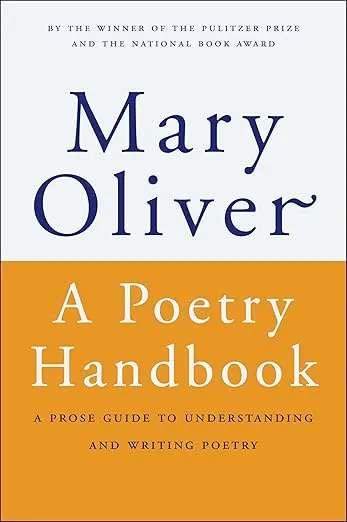
Of course, A Poetry Handbook is not merely valuable as a means to reading Chesterton. It is a gem in its own right, full of insights into art and the creative experience, pithy advice on how to write (and read!) well, and exemplary poems. Oliver is brilliant, witty, and clear as she teaches the language of poetry, successfully sharing with her readers her deep love and profound understanding of this beautiful literary genre. For more praise of Oliver and A Poetry Handbook, please revisit our Book Drop Day Post featuring Katie Marquette from the Born of Wonder Podcast and Substack, and Shari Dragovich from The Reader and the Writer Podcast and Substack.

Now, in the interest of not over-explaining an already explanatory book, I will spare you all the full play-by-play and instead share a few of my favorite things:
Favorite Things
In the Introduction, Oliver first presents an idea that she returns to numerous times throughout the book: that while “poets are born and not made in school,” there is nevertheless “a great deal that can, and must, be learned.” Oliver sees art as the love child of grace and skill, where the heart, if open to beauty, can join forces with the mind to capture that beauty via appropriate techniques and thus share it with the world. In the first chapter, “Getting Ready,” she draws out this analogy, noting that the heart and mind must make and keep regular appointments with each other if the love affair is to succeed in producing art.
I love Oliver’s comparison of the content of a poem to its soul, and the techniques of a poem to its body. Just as a man’s body reveals truths about his soul, so too should the techniques chosen by the poet reveal truths about the poem’s content. Likewise, knowledge of a man’s soul reveals truths about his body, and knowledge of the content of the poem can make obvious which techniques are being used (or should be used) to communicate the content effectively.
In “Reading Poems,” Oliver makes the case that studying the poetry of the past is essential if one wants to read or write modern poetry. After all, she claims, “the truly contemporary creative force is something that is built out of the past but with a difference.” To those unsure of their ability to connect meaningfully with ancient literature, she reassures that “The subjects that stir the heart are not so many, after all, and they do not change.” I appreciate this reminder that even though it can be intimidating to dive into an era or genre of art that is unfamiliar, we can rest assured that the same human experiences of wrestling with love, pain, loss, free will vs. fate, duty vs. desire, friendship, sacrifice, etc. haven’t changed at all over millennia. Thus it should not shock us when the list of “themes” for The Iliad, Harry Potter, Pride and Prejudice, and Wicked all share broad overlap despite their being produced by vastly different eras and being of vastly different styles.
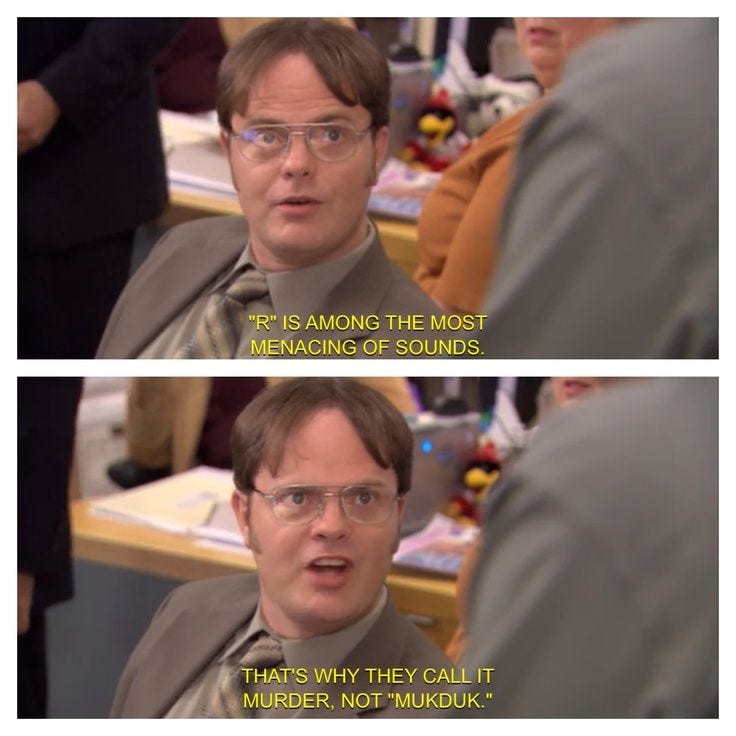
In her chapter “Sound,” Oliver explores the division of alphabetical sounds into vowels (a,e,i,o,u, and sometimes y and w), consonant semivowels (f,h,j,l,m,n,r,s,v,w,x,y,z, and soft c and g), and consonant mutes (b,d,k,p,q,t, and hard c and g). She then illustrates how the different sound families have different felt qualities; namely, semivowels are smoother, softer, gentler, and more fluid, whereas mutes are striking and more abrupt, which can heighten attention or cause amusement. Oliver focuses primarily on how the use of semivowels vs. mutes can be used to play with the attention of the reader, but I want to focus on how inherently funny mutes are for just a moment! For example, if you google the “funniest words in the English language” you find a list with quite a disproportionate number of b’s, d’s, k’s, p’s, t’s, and hard c’s and g’s… everything from the crass humor of words like “booty” or “egghead” to the slightly more classy but equally absurd “discombobulated”, “nincompoop”, or “flibbertigibbet”.
made me promise to point out that Dwight would agree…
After a very technical chapter, Oliver takes a moment to remind the reader why this kind of deep dive study into language is important for the aspiring writer. She notes:
“Verbal skills can be learned. They can be discussed and practiced. Then, a wonderful thing happens: what is learned settles, somewhere inside the chambers of the mind, where - you can count on it - it will “remember” what it knows and will float forth to assist in the initial writing.”
Confession time, this is the main reason why we have assigned A Poetry Handbook alongside The Ballad of the White Horse. Language skills don’t only help with initial writing, but with initial reading as well. Without the subconscious interpretive lenses that have “settled somewhere inside the chamber of the mind” it is challenging to read poetry and connect with it meaningfully. Poetry can feel like a foreign language, producing confusion instead of connection if there is no linguistic common ground. However, A Poetry Handbook sets out to provide a comprehensive summary of those missing lenses and links. Thus it is our hope, that armed with a poetically enabled subconsciousness, we can, after reading Oliver’s A Poetry Handbook, more fully enjoy Chesterton’s genius, and the genius of other poets and artists as well.
More Devices of Sound - Speaking of the Ballad, I dare you to open up The Ballad of the White Horse again to find examples of alliteration, consonance, and assonance! Chesterton is an absolute master of these poetic techniques. My favorite example is from the Dedication:
         “O go you onward; where you are
Shall honour and laughter be,
Past purpled forest and pearled foam,
God’s winged pavilion free to roam,
your face, that is a wandering home,
       A flying home for me.”
Oliver’s defense of free verse, not as a rejection of traditional metrical poetry, but as the natural result of the shift in how poetry is primarily consumed (from a primarily auditory experience to a primarily visual one) is a powerful reminder to critics of modern art to ask why tradition has been forsaken instead of merely decrying that it has been… it might be more of a practical matter than a moral one in some cases!
The regular, metrical line gave assistance to a listener who sought to remember the poem; the more various line breaks of the “visual” poem gave assistance to the mind seeking to “hear” the poem.
Oliver’s discussion of how universal images come primarily from the natural world also reminds me of Jason Baxter’s Why Literature Still Matters. Both
“The reader without perceptual experience with the natural processes is locked out of the poetry of our world”
and
“If the poem is thin, it is likely so not because the poet does not know enough words, but because he or she has not stood long enough among the flowers”
remind me of Baxter’s argument that we must physically experience the universe through nature and travel in order to participate fully in literature, which uses natural images help us feel connected to people and places that we otherwise could not fathom.
I love Oliver’s closing comparison that just as athletes must nurture their bodies: “Writers must similarly take care of the sensibility that houses the possibility of poems.” The idea that creative output flows from and reflects the soul of the artist is both Aristotelian and Thomistic. If we make a habit of dishonestly calling ugly things beautiful, eventually they do in fact seem to be beautiful to us. Thus artists must take care to be true to reality, lest in losing the true, they lose the beautiful as well.
Discussion Ideas
Are you familiar with any of Mary Oliver’s poetry? If so, what is your favorite poem of hers, and why?
I find the quote Oliver shares from Flaubert: “Talent is long patience, effort of will, and intense observation, all of which can be practiced” to be so very encouraging! What talents (literary or non) do you want to recommit yourself to practicing this advent, or in this coming new year? Or should I say, “Tell me, what is it you plan to do with your one wild and precious life?”
Oliver highlights the fact the modern poetry is intentionally intimate, with poets preferring to approach the reader as a friend rather than presenting ideas as a teacher. What do you think has contributed most to this shift? Which style of poetry do you prefer?
And a less personal and more intellectual one: how might Keat’s concept of negative capability relate to Caryll Houselander’s concept of “emptiness” as a prerequisite of creative potential as seen in the first chapter of The Reed of God?
Reading Resources
Close Reads did a wonderful tribute podcast on Mary Oliver on the occasion of her death in 2019. Great listen for anyone interested in learning more about Oliver and her influence on the modern poetry scene!

Reconciling Oliver’s spiritual depth with her stark breaks from tradition and orthodoxy in her personal/faith life can be a real challenge. Mary Oliver and the Shapes of God by Andrew Callis provides an interesting defense of Oliver’s spiritual priorities, citing her joy, profound appreciation of mystery, understanding of teleology, and love of nature and beauty as reasons why Christians should feel confident in enjoying her work. I have numerous theological critiques of both Oliver and Callis’ article… but I will here refrain from throwing the baby out with the bathwater. After all, the baby is very cute, and has an abundance of ontological goodness despite its flailing about in murky water.
If you are interested in reading more poetry, I highly recommend The Top 500 Poems, edited by William Harmon, who also provides excellent commentary on each poem. This is my go-to anthology!
Finally, in case you missed it, here is our intro podcast for The Ballad of the White Horse and A Poetry Handbook!
Until next time, keep revisiting the good books that can enrich your life and nourish your soul.
What We’re Reading Next:
January
Merchant of Venice by William Shakespeare

February-April
Kristen Lavransdatter by Sigrid Undset

A Few Reminders:
If you are wanting to get in on the in person or virtual community please contact us!
We have turned on paid subscriptions which will allow you to support the work we are doing here.
If you would like to make a small contribution to the work we’re doing here at Reading Revisited, we invite you to do so with the Buy (Us) a Coffee button below. We so appreciate your support!
*As always, some of the links are affiliate links. If you don’t have the books yet and are planning to buy them, we appreciate you using the links. The few cents earned with each purchase you make after clicking links (at no extra cost to you) goes toward the time and effort it takes to keep Reading Revisited running, and we appreciate it!